
A penetration test can tell you whether an application was vulnerable at the time it was tested. It cannot tell you whether the same application is secure after six months of new releases, infrastructure changes, and newly disclosed vulnerabilities.
Yet, many organisations still treat an annual penetration test as their primary evidence of security assurance. They commission a test, remediate the findings, file the report for the next audit, and then move on.
That approach is not inherently wrong. Annual penetration testing provides a valuable independent assessment, and for stable environments it may be entirely appropriate. The problem is assuming that a test that was conducted months ago will still provide an accurate view of the attack surface.
The question is not whether annual penetration testing has value. It is whether the interval between tests matches the rate at which your systems, exposure, and risks change.
Why annual testing became the norm
The annual testing cadence is partly a product of compliance requirements, audit cycles, and procurement budgets. For many organisations, one pentest per year has become the default because it provides a defined scope, a dated report and evidence that security testing has taken place.
PCI DSS includes specific penetration-testing requirements, testing at least annually and after significant changes. ISO 27001 requires organisations to manage technical vulnerabilities, but does not prescribe a universal annual penetration-testing schedule. SOC 2, likewise, does not impose a blanket annual penetration-testing requirement (although auditors and customers may expect testing as evidence of effective security controls).
Meeting a compliance requirement establishes a baseline; it does not automatically mean that the frequency of testing is appropriate for the organisation's current risk.
For many smaller organisations with stable systems, a thorough annual penetration test remains a reasonable starting point. The problem arises when the annual compliance milestone becomes the entire security-testing strategy.
What changes in a year
The question worth asking is not simply "have we been tested?" but "have we tested the system as it exists today?"
Several types of change can make the answer less straightforward than an annual report might suggest.
Codebase changes. Development teams regularly introduce new features, modify existing functionality and update dependencies. Each material change can introduce vulnerabilities, particularly where authentication, authorisation, data handling or API functionality is affected. New third-party libraries also introduce dependencies that need to be managed and updated as new risks emerge.
Infrastructure changes. Cloud environments and internet-facing services can change frequently. New accounts are created for projects, subdomains are added, services are migrated and SaaS integrations gain access to production data. Some assets may fall outside the scope of the previous penetration test, leaving their security unassessed.
Identity and access changes. Employees join and leave, contractors finish engagements, and administrative responsibilities change. These transitions can leave accounts, tokens or permissions active longer than intended. New identity integrations and changes to privileged access can also introduce weaknesses that were not present during the previous assessment. Routine access reviews remain important, while penetration testing can help assess whether weaknesses in access controls can be exploited.
Changes in the threat landscape. New vulnerabilities and exploitation techniques emerge throughout the year. A service that was not known to be vulnerable during an assessment may subsequently require investigation when a new vulnerability is disclosed. The appropriate response depends on the affected technology, its exposure and the potential impact; not every new disclosure requires a penetration test.
Consider a SaaS application tested in January. The assessment identifies several weaknesses, which the development team fixes. In April, the team introduces a new API endpoint and changes how customer permissions are checked. In June, a cloud migration introduces another internet-facing service.
The January report remains useful, but it does not establish whether the new endpoint, revised permissions or additional service are secure. A targeted assessment after the April release, combined with ongoing discovery of internet-facing assets, would provide a more current view without necessarily requiring a full reassessment of the entire environment.
None of this means that annual testing is ineffective. It means that the value of an assessment must be considered alongside what has changed since it took place.
What a point-in-time test can and cannot tell you
A well-conducted penetration test provides meaningful security assurance. Experienced consultants can identify issues that automated scanning alone may miss, including business logic flaws, authentication weaknesses, privilege escalation paths and vulnerabilities that become apparent only when multiple issues are combined.
Those findings remain useful after the engagement ends. Remediation work can reduce risk, and the report provides a record of what was tested, what was found and what needs to be addressed. It can also help your developers and administrators improve their secure development and administration practices.
What changes over time is how much the report aligns with the current state of the system. Some findings may have been fixed, others may remain unresolved, and new weaknesses may have been introduced. The scope and testing methods also determine what the assessment can reasonably establish.
A report with no critical or high-severity findings should therefore be interpreted in context. It describes the results of a particular assessment, not a guarantee that the system is free from vulnerabilities. Its value depends on the scope, the depth of testing, the conditions under which it was conducted, and the changes made since the previous pentest.
Security leaders should bear this in mind when reporting assurance to boards, executives, customers, and auditors. The results of a previous penetration test are useful evidence, but they should be considered alongside the remediation status, vulnerability management, material system changes, and any subsequent testing.
The objective is not to discard the point-in-time testing approach. It is to avoid relying on it as the sole measure of security between assessments.
When is an annual penetration test enough?
Annual testing can be appropriate when the environment is stable, the scope is well understood, and the organisation has effective processes for identifying and managing vulnerabilities between assessments.
It may be a reasonable approach where:
- The application or network changes infrequently, with few changes to functionality, architecture or access controls.
- The scope is small and well-defined, such as a brochure website or a relatively simple office network.
- The organisation has limited external exposure and an effective process for identifying new assets and addressing vulnerabilities.
- Compliance requirements and customer commitments can be met through an annual assessment, with no additional risk factors that justify more frequent testing.
These conditions do not remove the need to reassess security when there are larger changes. A migration, a new authentication provider, a significant application release, or the introduction of a new internet-facing service may justify testing before the next scheduled engagement.
An annual test should also sit alongside routine vulnerability management. Automated scanning, patch management, access reviews, and monitoring can help identify issues that may arise between penetration tests.
What does more frequent testing look like?
There is no single testing frequency that suits every organisation. The right approach depends on how quickly the environment changes, the sensitivity of the data involved, the potential business impact of a compromise and the organisation's compliance obligations.
Our guide to how often to get a penetration test explains the relevant considerations in more detail. In practice, several approaches can help organisations move beyond a single annual assessment.
Test after significant changes. A major release, migration to a new hosting environment or change to an authentication provider can alter the security of an application. A targeted assessment of the affected components may be more appropriate than waiting for the next annual test. The scope should reflect the change and its potential impact, including any dependencies or integrations affected by it.
Prioritise higher-risk systems. Not every application or network needs to be tested at the same frequency. A customer-facing application that handles sensitive data and receives frequent releases may warrant more regular assessment than an internal tool that rarely changes. External infrastructure penetration testing can also help assess the security of internet-facing systems as the environment evolves.
Schedule recurring manual testing. For organisations with frequently changing applications or higher levels of exposure, recurring penetration testing can provide opportunities to assess new functionality, revisit previous findings and investigate areas of concern throughout the year. The frequency should reflect the rate of change and the risk involved, rather than being chosen solely because a particular schedule is available.
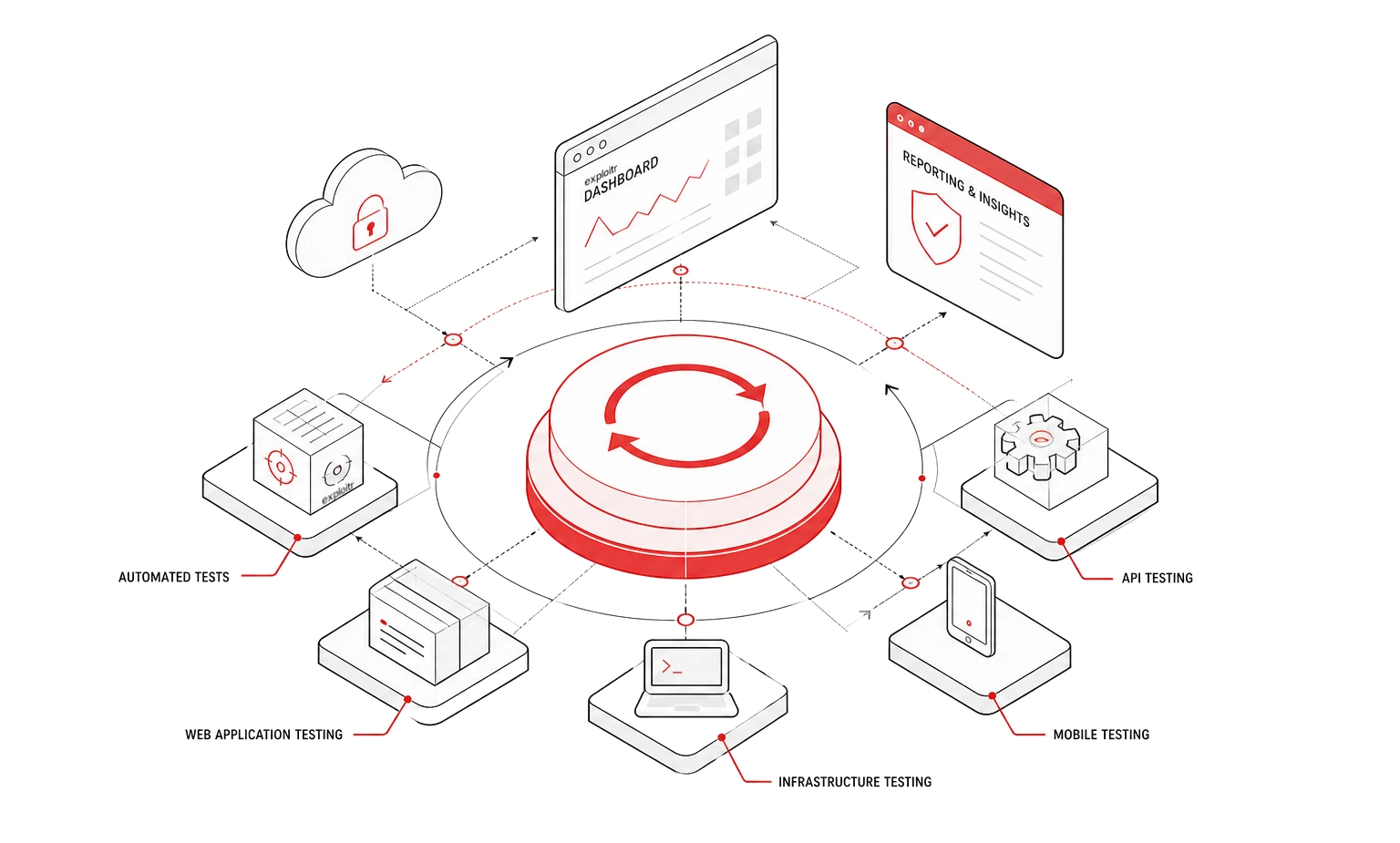
Use attack-surface monitoring between assessments. Continuous discovery helps identify internet-facing assets that may not have been included in the previous assessment. A platform such as the Exploitr platform can help organisations maintain visibility of their external attack surface as it changes. Discovery and monitoring do not establish whether every weakness is exploitable, so they should complement rather than replace independent testing.
How to change from an annual cadence
The practical barrier for most security leads is not convincing themselves that more frequent testing is better. It is navigating the budget process and making the case to stakeholders who may have become accustomed to approving one line item per year.
A few things that make this easier:
Start by mapping your highest-change systems rather than trying to increase testing frequency across everything at once. Web applications that are under continuous development are a prime example where the application changes weekly, so the pentest report from last year has the shortest shelf life.
If compliance frameworks require annual testing, keep that engagement. Use it for depth on the parts of your environment that do not change quickly. Then make a separate case for targeted testing tied to specific change events, which is often cheaper because the scope is narrower. Our penetration testing pricing guide shows what drives costs.
Budget for retesting as part of development cycles rather than as a standalone security project. When a new product release is planned, include a security assessment in the delivery timeline. This makes testing a project cost rather than a separate security budget item, which can be easier to get approved.
Annual penetration testing remains a necessary control, and the argument for it has not changed. It should not, however, be treated as the only mechanism for assessing security.