IoT & Hardware Security Testing

Your devices are connected. Are they secure?

Full-stack security testing of hardware products and IoT devices - hardware interfaces, firmware analysis, wireless protocols, and the full ecosystem including mobile apps, web dashboards, and cloud platforms.
Embedded device security testing and IoT penetration testing services

What is Embedded Device Security Testing?

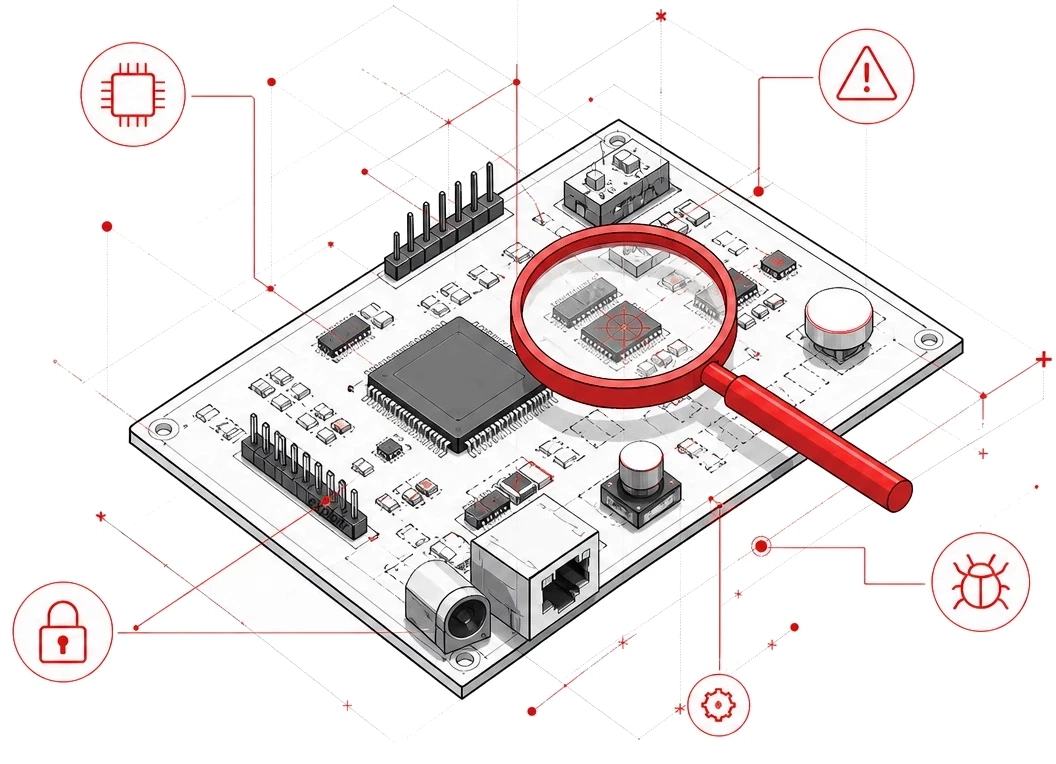
Embedded device security testing, also known as hardware penetration testing or IoT security testing, is a specialised area of security assessment focused on identifying vulnerabilities in connected hardware products. This includes not only the physical device itself but also the firmware that runs on it, the hardware interfaces it exposes, the wireless communication protocols it uses, and the broader ecosystem of applications and cloud services that support it.

Whether you're developing smart home devices, industrial sensors, medical equipment, automotive components, or consumer electronics, our testing identifies vulnerabilities across the entire product lifecycle: from manufacturing and deployment through updates and end-of-life.

A single vulnerability in an embedded device can affect thousands or millions of deployed units, making pre-release security testing critical for product reputation, customer safety, and regulatory compliance.
Our Testing Methodology

What our embedded device testing includes

Embedded device and IoT security testing covers the full attack surface of connected hardware products from firmware and hardware interfaces, through to the mobile applications and cloud platforms that support them.
01

Firmware Analysis

Extraction and analysis of device firmware to identify hardcoded credentials, insecure update mechanisms, exposed debug interfaces, and cryptographic weaknesses in stored code and configuration.
02

Hardware Interfaces

Assessment of JTAG, UART, SPI, I2C, and other debug and programming interfaces that could provide unauthorised access to firmware, encryption keys, or operating system shell access.
03

Wireless Protocol Testing

Bluetooth, BLE, Zigbee, Z-Wave, proprietary 433/915 MHz protocols, and Wi-Fi interfaces are assessed for authentication weaknesses, replay attacks, and eavesdropping vulnerabilities.
04

Mobile Application & Backend API

The companion mobile application, web dashboard, and backend APIs that the device communicates with are assessed as part of the full ecosystem. Authentication, authorisation, and data handling are all in scope.
05

Cloud Platform Security

Device-to-cloud communication, credential storage, over-the-air update mechanisms, and cloud platform configuration are assessed for vulnerabilities that could affect device security at scale.
06

Physical Security

Physical tamper resistance, debug port exposure, and whether an attacker with physical access to the device can extract sensitive material or modify device behaviour.

Pricing

From £4,500

for embedded device penetration testing

Not sure where your device fits? A 30-minute scoping call is free and gets you a fixed written quote.

No obligation · Strictly confidential · Quote within one business day

What's Included

  • Fixed-price proposal within one business day
  • Manual, consultant-led testing. Not automated scans
  • Report within 2 business days of testing completion
  • No obligation quote, all enquiries are fully confidential

Key Deliverables

What's included in the assessment?

Every embedded device security assessment is delivered as a defined set of outputs supporting both technical remediation and executive decision-making.

Executive Report

A non-technical summary of findings with risk ratings and recommendations suitable for board, product, and senior management stakeholders.

Technical Report

Detailed findings with reproduction steps, severity scoring, remediation guidance, and mappings to CVE, CVSS, and relevant IoT security frameworks where applicable.

Debrief Session

An offer of a debrief call to walk through findings, discuss remediation priorities, and answer questions from both technical and executive stakeholders.

Attack Surface Center Access

Complimentary access to our Attack Surface Center ASM platform for collaborative tracking and remediation management throughout and beyond the engagement.

Consultant-led Testing

All testing is consultant-led by in-house staff. Your consultant works with you from scoping through to debrief - nothing is outsourced or subcontracted.

Common Questions

Embedded device security testing - frequently asked questions

Not required, but highly recommended. We can perform black-box testing with just the physical device. White-box testing (with source code and hardware design files) provides more thorough coverage and enables earlier vulnerability identification. Most comprehensive assessments include both firmware analysis and source code review.

Typically 1-2 units. Hardware testing can be invasive - opening enclosures, probing interfaces, potentially damaging units. Having backup devices ensures complete testing even if one unit is affected. For products with multiple hardware variants, we may need samples of each.

Yes. Pre-production testing is often more valuable as findings can be addressed in hardware and firmware revisions before manufacturing at scale. We can work with development units and prototype hardware.

Yes, ecosystem testing is included or available as an add-on. The mobile application, web dashboard, and backend API are integral to the full-stack security posture of any connected device. Combined testing typically provides the most complete coverage.

Some testing methods are invasive and may damage units, particularly when accessing internal hardware interfaces, removing chips, or performing fault injection. This is why we require multiple samples. We always inform you before performing any potentially destructive testing and can adjust our methodology if device preservation is critical.

We test all types of connectivity including Bluetooth, Zigbee, Z-Wave, proprietary RF protocols, and even devices with no wireless connectivity. Non-connected devices still have attack surfaces through physical interfaces, local USB connections, and firmware vulnerabilities.

We routinely sign NDAs and maintain strict confidentiality. All testing is performed in our secure lab, and we never disclose findings publicly without explicit permission. Your firmware, schematics, and proprietary information remain confidential. We can also test on-site at your facility if preferred.

We provide detailed remediation guidance and recommendations, but we don't modify your firmware or hardware designs directly. This maintains independence and objectivity in our testing. However, we're available for consultation during your remediation process.

We immediately notify you of critical findings rather than waiting for the final report, typically within 24 hours of discovery, but usually sooner once we have confirmed our findings. This allows you to begin remediation immediately.

For products already deployed, we can help you develop a coordinated and responsible disclosure plan.

Timeline varies significantly based on device complexity:

  • Simple devices (single function, basic connectivity): ~1 week
  • Standard devices (typical IoT product with app/cloud): 2-4 weeks
  • Complex devices (medical, automotive, multiple protocols): up to 6 weeks in some instances

We'll be able to provide a more concrete answer during a scoping conversation that's customised to your requirements. If we require additional time to complete testing up to our expected standard, then no additional time would be charged.

Ready to test your embedded device or IoT product?

Get a fixed-price quote within 24 hours. Our team will review your device's architecture and provide a tailored testing proposal that fits your timeline and budget.