Web Application Penetration Testing
Your web app has vulnerabilities. Let's find them first.
Accreditations and memberships



Application Security Testing
What is web application penetration testing?
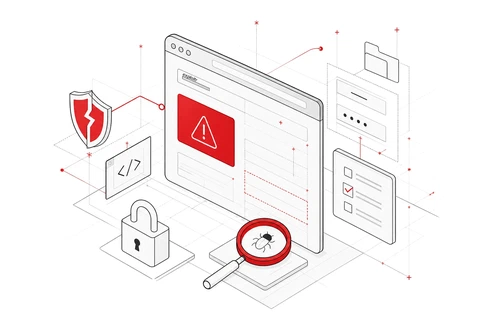
Web application penetration testing aims to identify vulnerabilities that could allow an attacker to access data, bypass controls, or abuse functionality. By simulating real-world attack techniques, penetration testing helps organisations understand their true exposure and to prioritise remediation based on business risk and impact.
This type of testing is particularly important for applications exposed to the internet or used by customers, partners, or internal staff. If you're preparing for your first assessment, our guide to scoping a web application penetration test covers what to prepare and what to expect.
Typical web application attack surface
- Authentication & session handling
- Access control & user roles
- Injection & input handling
- Business logic & workflows
- APIs & third-party integrations
Why it matters
Who Needs This
Who needs web application penetration testing?
SaaS and platform providers
Financial services
Healthcare organisations
Startups with new deployments
Our Pentest Methodology
OWASP aligned testing approach
Our methodology is aligned with the OWASP Web Security Testing Guide (WSTG), OWASP Application Security Verification Standard (ASVS), and OWASP Top 10, combining manual testing with intelligence-driven discovery to uncover vulnerabilities that automated scanners miss.
Each assessment is tailored to your application's technology stack, authentication model, and business logic.
Authentication & Authorisation
Injection Vulnerabilities
Business Logic Flaws
Session Management
API Security
Client-Side Security
Access Control
Infrastructure & Configuration
Testing scope
How we scope testing: authenticated and unauthenticated
Unauthenticated testing
Simulates an anonymous attacker with no credentials. This covers publicly accessible functionality, input validation, error handling, and vulnerabilities reachable without an account.Authenticated testing
We test across all privilege levels your application supports, from standard user accounts through to administrator roles, targeting privilege escalation, insecure direct object references, and access controls that fail under real-account conditions.Self-Registration
If your application allows self-registration, we use that workflow. If not, you provide a set of sample credentials and we work from there. Many applications benefit most from a realistic grey-box approach that reflects what an attacker who has legitimate access could achieve.White Box - Source Code
Where source code or architecture documentation is available, we can incorporate that context into a more informed review.
Pricing
From £2,700
for web application penetration testing
Not sure where your application fits? A 30-minute scoping call is free and gets you a fixed written quote.
No obligation · Strictly confidential · Quote within one business day
Pricing Examples
| Standard web app (unauthenticated or low complexity) | £2,700 - £4,500 |
| Medium complexity SaaS (multiple roles) | £4,500 - £6,300 |
| Complex enterprise platform | £6,300+ |
What's Included
- Fixed-price proposal within one business day
- Manual, consultant-led testing. Not automated scans
- Report within 2 business days of testing completion
- Free focused-retesting included to verify remediation
- No obligation quote, all enquiries are fully confidential
How We Work
A proven engagement process
Scope agreement
Reconnaissance
Manual testing
Findings report
Debrief session
Free retest
Pentest reports built for technical and executive teams
Every engagement produces a report built for two audiences: technical teams who need the detail to fix issues, and business stakeholders who need to understand the risk.
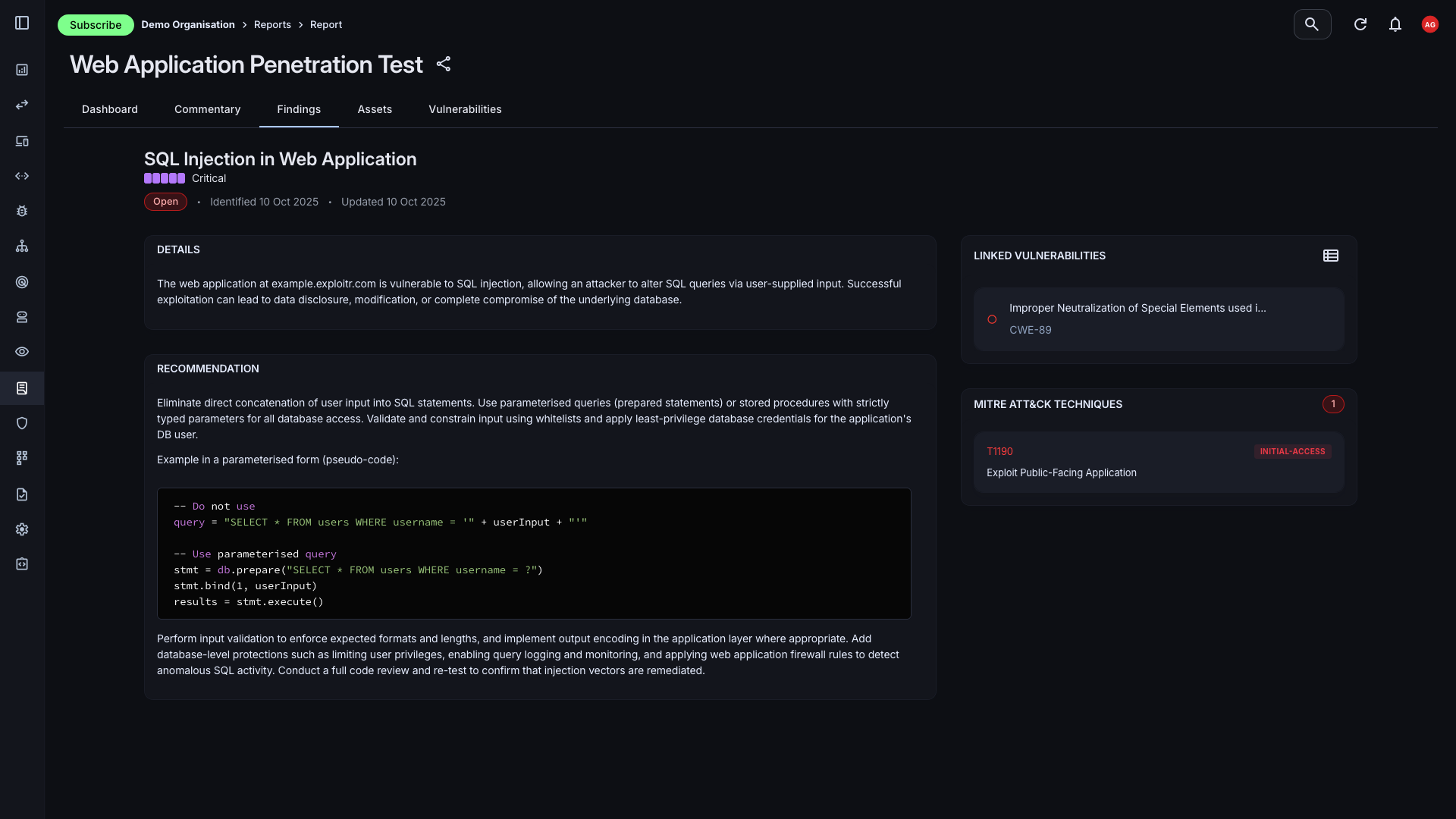
Findings are tracked live in Attack Surface Center throughout testing, so you're not waiting until the end to see what we've found.
- Executive summary: A concise overview of risk, critical findings, and recommended next steps, written for non-technical stakeholders.
- Technical findings: Each vulnerability documented with a severity rating, reproduction steps, affected component, CVSS score, and remediation guidance.
- Live findings in Attack Surface Center: View findings as they're logged, track remediation progress, and collaborate with your team in real time, not just at the end.
- Free retesting included: Once you've fixed the issues, we verify the remediation at no extra cost.
- Consultant continuity: The same consultant runs your engagement from scoping through to debrief. Nothing is subcontracted or outsourced.
Ready to secure your web application?
Common Questions
Web application penetration testing - frequently asked questions
Most web application pentests take 3-6 days depending on the scope and complexity of the application. Testing can be performed against development, staging, or production environments.
Reports are delivered within 2 business days of testing completion. For a full walkthrough of what happens from scope agreement through to report delivery, see what to expect during a web application pentest.
Whilst penetration testing comes with an inherent risk, we use safe testing techniques and coordinate with your team to minimise any potential impact.
Testing is typically performed in non-production environments, though production testing can be conducted with appropriate safeguards in place.
Yes, API testing is included when APIs are part of the application's functionality. The scope is based on the application's functionality, not the number of endpoints.
For API-only applications, we offer dedicated API penetration testing.
We test both as an anonymous attacker and as authenticated users across different privilege levels to identify privilege escalation and access control issues.
If your application offers the ability for users to self-register, we also focus on targeted vulnerability discovery of this workflow. If your application doesn't offer self-registration, then we would ask you to provide us with sample user credentials in order to perform authenticated user testing.
Yes, we regularly test React, Angular, Vue applications and other modern frameworks, including their API backends and client-side logic.
We use automated tools to enhance discovery efficiency, but testing is entirely manually-led and intelligence-driven. Every finding is validated and exploited by our consultants.
We do not run a vulnerability scan and call it a day.
Yes, we can test web applications regardless of the underlying platform or technology stack.
This includes CMS-based sites such as WordPress and WooCommerce, e-commerce platforms like Shopify, custom-built applications in any language or framework (PHP, Python, Node.js, .NET, Ruby on Rails, etc.), and SaaS platforms built on modern stacks like React, Angular, or Vue with API backends.
The approach is tailored to the platform:
- For WordPress sites, we assess plugin vulnerabilities, theme security, authentication controls, and common CMS misconfigurations.
- For Shopify, testing focuses on custom app logic, third-party integrations, and checkout flows.
- For custom-built applications, we conduct a thorough assessment of the full application surface, looking at the authentication, authorisation, business logic, data handling, and API security.
If you're unsure of what you may need for your website or application pentest, get in touch. We're happy to discuss your environment during a brief scoping call.
Annual testing at minimum, with additional testing after major releases, significant feature additions, or architectural changes.
Many organisations benefit from continuous testing through our Pentest as a Service offering.
We recommend scheduling a web application penetration test at least 4-6 weeks before a product launch or major release. This allows time for testing, reporting, and remediation of any critical vulnerabilities that may be discovered.
If your timeline is shorter, we can discuss expedited testing options. Schedule a scoping call to discuss your product, launch timeline, and testing needs.