

What we know so far
GitHub is investigating unauthorised access involving a number of its internal repositories.
According to GitHub's public statements, the incident involved a compromised employee device associated with a malicious Visual Studio Code extension. GitHub says it removed the extension, isolated the affected endpoint, and initiated incident response procedures.
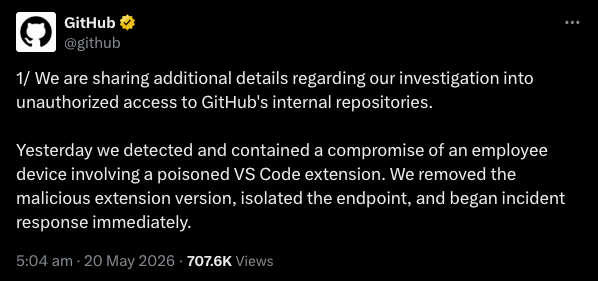
https://x.com/github/status/2056949168208552080
The investigation is ongoing. GitHub has stated that it is reviewing logs, validating secret rotation activity, and monitoring for potential follow-on activity. The company has also said it intends to publish additional details once its investigation is complete.
At the time of writing, GitHub says it has not identified evidence that customer repositories, enterprise accounts, or customer data outside GitHub's internal repositories were affected. As with any active incident investigation, additional information may come to light as further forensic analysis is completed. GitHub has stated it will notify affected customers through its established incident response processes if that position changes.
While there is currently no indication of customer compromise, incidents involving major development platforms are a useful reminder to review assumptions around supply-chain trust, credential exposure, and operational dependency.
Reviewing your exposure
Secrets stored in GitHub
GitHub repositories and Actions are commonly used to store and access credentials: API keys, cloud provider tokens, deployment secrets, and service account credentials. These are often added over time and not regularly audited.
Organisations should consider:
- Auditing what secrets are currently stored across your repositories and Actions environments.
- Identifying secrets that provide production, infrastructure, or administrative access, and prioritising those for review or rotation.
- Removing secrets that are no longer in use.
- Replacing long-lived static credentials with short-lived, role-based access where possible.
Where supported, OpenID Connect (OIDC) federation with cloud providers can reduce the need to store long-lived cloud credentials within GitHub at all.
Dependency on GitHub Actions and third-party workflows
Many CI/CD pipelines rely on GitHub Actions maintained by third parties.These are referenced by name and version, and a compromised action could introduce malicious steps into your build process.
Organisations should review:
- Which third-party Actions are currently in use.
- Whether Actions are pinned to immutable commit SHAs rather than mutable tags such as
@v3. - Whether critical build or deployment logic should be maintained internally rather than relying on external workflows.
Pinning Actions to a full commit SHA reduces the risk of a mutable tag being repointed to malicious code.
Organisations using self-hosted runners should also review whether runners are appropriately segmented from production systems and whether runner persistence is tightly controlled.
Separately, there has been an influx of dependency related supply chain attacks over the last 6+ months. Pinning your dependencies is one small action that can help to reduce the potential for compromise.
GitHub as an identity provider
Many internal tools and third-party services are configured to authenticate via GitHub OAuth. A compromise affecting authentication or OAuth-related systems could have implications for those trust relationships.
Organisations should review:
- Which internal or third-party systems accept GitHub as a login method.
- Whether those systems have appropriate fallback authentication and session controls.
Blast radius if access were lost or disrupted
Security incidents are not limited to confidentiality concerns. Organisations should also consider the operational impact if GitHub access were temporarily unavailable or degraded.
Areas worth reviewing include:
- Which development or deployment processes depend entirely on GitHub availability.
- Whether critical artefacts and packages are mirrored or cached independently.
- Whether repository mirrors or offline backups are maintained outside GitHub.
- Whether recovery procedures have been tested rather than assumed to work.
Final thoughts
At present, there is no public evidence that customer repositories or enterprise environments have been compromised as part of this incident.
However, incidents involving widely trusted development platforms are a useful opportunity to reassess dependency, credential management, CI/CD trust boundaries, and resilience planning.
None of the recommendations above imply customer compromise is known or expected. They are standard supply-chain and operational security practices that become especially relevant whenever a major service provider reports a security incident.
References
- GitHub official status updates on X
- GitHub incident response guidance
- GitHub: Prevent data leaks
- The Hacker News